
In September of last year I wrote a series of pieces looking back at the then fifty-year-old television series Space:1999. Those posts continue to get regular hits, which made me think it might be a good idea to collect and string them together so interested parties don't have to bounce around looking for the other parts.
Keep in mind that the series would today be celebrating its 51st birthday.
Looking back at the 50th!....
Enjoy!
* * *
Space:1999/50 — Fifty Years Ago?
I can't believe I started high school fifty years ago. I also can't believe that the television series Space:1999 premiered fifty years ago. For me, both were somewhat disappointing, with the scholastic side lasting a few more years, too many years, but with better characters aboard... although the second season was a definite improvement.
What?
Let me explain.
Over the next few days I'll run a series of my own: a 13-part look-back in nostalgia at Space:1999.

* * *
Space:1999/50 ― Breakaway from Earth

Summer, 1975. As per my usual habit after arriving at my local shopping mall, I immediately made my way to W.H. Smith, the bookstore. After perusing the shelves for a few minutes my eyes made contact with two particular pocket books sharing the same main title: "SPACE: 1999"
One book was black and one pink. On the covers were some eye-catching photos. What was this? Well, according to the books' back cover text, Space:1999 was a new and exciting science fiction television programme from ATV.
I'd have to wait a couple of months for this new and exciting show to premiere.
French CBC premiered Space:1999 here in Canada on Monday, September the 1st ― Labour Day. For the English-language premiere of "Breakaway", the show's opening episode, I'd have to wait till 10:30am on the following Saturday. That's right, CBC affiliate CKVR programmed Space for Saturday mornings ― they were not alone in this regard. (Due to the majority of television networks taking a pass on the series, it had to be sold on a station-by-station basis.) Hamilton, Ontario, independent station CHCH gave a little more respect: Sundays at 5.30pm.
UFO, a previous Gerry and Sylvia Anderson SF series, had been given a full-network run by CTV (Canadian Television) beginning in 1970. No doubt CTV was pitched on buying the producing team's latest show, but they passed. French CBC ("Radio Canada") bought in, but the Canadian Broadcasting Corporation's English-language side waited until the second, and as it turned out, final, year of Space before committing to a coast-to-coast transmission. In the Toronto television broadcast market, that meant "Saturdays at 5pm".
Before I go I have to say something controversial. After all, my piece thus far has been pretty "vanilla": While it had problems of its own, the second year of Space:1999 was an overall improvement on Year One.
"SPACE: 1999" (Orbit Books)
and astronauts prepares for man's first venture into
deep space . . . On the far side of the moon catastrophe
threatens as the nuclear waste dumped there edges
towards critical mass . . .
* * *
Space:1999/50 — Earthbound (Review)

"Earthbound" is one of Space:1999's finest hours.
When the promising Space premiered in September of 1975, I was there in front of the colour tube to welcome another starfield patch... even if stars were a bit on the scarce side in this colourful import from the UK. Since I know the old SF television series very well, due to my then space cadet rating, I can pick and choose what I want to watch. And I choose this episode.

Simmonds is the floating variable in "Earthbound". Visiting alien leader Zantor, portrayed most effectively by some dude named Christopher Lee, is an unknown quantity in a friend-or-foe sense; but having the boisterous bureaucrat producing his own sneaky threat made for interpersonal drama that was all too rare on Space:1999. (Year One, that is; Year Two was a huge improvement in that regard.) This dynamic sets up and plays out the themes of "nobility" and "trust".

Postscript: Along with "Mission of the Darians", "Ring Around the Moon", "Journey to Where", and "One Moment of Humanity", "Earthbound" is the Space episode I've watched most often.
* * *
Space:1999/50 — Ring Around the Bathtub (Review)

I copped "Ring Around the Bathtub" from a friend of mine. That mocking title about sums up Space:1999's most rotten Year One episode: "Ring Around the Moon"
For as much as I like to point out its badness, I find myself being strangely drawn toward this "Ring". There is something I cannot explain about its appeal. Perhaps it's lines like "This is Triton's universe" that keep drawing me back, time and again, with "Plan 9" pleasures. By the way, outside of noting "Triton's sun", "This is Triton's galaxy" is all we need to know. Specifying a universe is completely unnecessary. Unless we're talking of alternate or multi-universes, stating that Triton is of a particular universe is wholly redundant in a uni-universe paradigm.
(This kind of ineptness, unfortunately, happened far too often on Space:1999 ― science fiction produced by people who didn't understand science fiction, which might explain why the show's first season worked best as "horror". The second, and final, season was less horrific.)
The film editing in "Ring Around the Moon" is rough, giving the viewer the impression that there were problems in editorial. The inter-cutting between scenes is often awkward and disjointed; as though a scene or two is missing here and there. Perhaps the script was missing a scene or two, here and there. Without having access to the original script, it's hard to know what happened.

The episode's narrative-logic is also "off". Its opening scene contains one of those crewmembers-going-berserk moments. Fine. But this serious matter goes on for two minutes before Dr. Helena Russell yells to Sandra Benes, "Sandra, get security!" No! What took you so long? Anyone?
Perhaps the biggest problem with the episode is the awful acting, especially by Martin Landau; even the usually above-the-fray Barry Morse suffers from unconvincing deliveries. (In all fairness, Morse thought he was working in a nuthouse with this program. Morse left Space at the end of the first season, telling the producers something like "I'm going off to play with the grownups now".) The one person who shines here is Barbara Bain as Dr. Russell. Her performance is restrained, and applicably subtle. The good news is that Bain had a chance to show her thespian stuff in Space:1999's slightly improved second season.

One element in "Ring Around the Moon" is outstanding: The music; not composed by Barry Gray in this case, but by Vic Elms and Alan Willis. Its sparseness and rawness adds to the out-of-whack nature of the episode's storyline. As a matter of fact, the score's "beat" would foreshadow Derek Wadsworth's vibrant and fitting Year Two music.
(For me, Barry Gray, as much as I love his work on previous Gerry & Sylvia Anderson programmes, was clearly not into this series ― one indicator of this was the composer's reuse of themes he had originally written for the 1969 Anderson feature film Doppelganger [Journey to the Far Side of the Sun]. One can also hear a major smack of his opening theme tune for the 1968 film Thunderbird 6 in the Space title music. Composer Gray produced some fine cues for Space:1999's first season, but most were seemingly telexed in.)
Like a few episodes of this series, "Ring Around the Moon" is best viewed at 2 o'clock in the morning, I think. Which will be the time of the day when I'll watch this one again....
Postscript: Along with "Earthbound", "Mission of the Darians", "Journey to Where", and "One Moment of Humanity", "Ring Around the Moon" is the Space episode I've watched most often. Yes, I did admittedly open this piece with "Space:1999's most rotten Year One episode", but I also said that I find myself being strangely drawn toward "Ring Around the Moon". Not a lot makes sense.

* * *
Space:1999/50 ― Opening Titles: Year One
My introduction to Space:1999 happened in the early evening of Monday, September 1st, 1975, when CBLFT (the CBC's French-language flagship station) premiered it here in the Toronto-area market. I did not see the colourful new SF series in colour that day, as I had watched it on the 10-inch black-and-white Sony portable in my bedroom. (The chromatic, and English-language, version of Space awaited me the following Saturday morning. This then space cadet was there with bells on to greet "Breakaway", the series opener.) The dynamic visuals alone, even in a monochromatic state, were worth the price of admission. My initial reaction to this television series theme music? Good! Till the 22-second mark: that's when the twangy electric guitar took over. I remember wincing. "That's corny."
The theme was composed by Barry Gray, the talented music man of Gerry and Sylvia Anderson film and television productions. His stellar contributions were an important part of the Anderson's successes. In the case of Space:1999, maestro Gray made the series seem more important, and better, than it actually was. One could argue that the best parts of Space, its first season, that is, were the opening and closing title sections. ("Sections"? Sorry, that's a carryover from when I worked in "titles and opticals".)
Most memorable were the opening title "This Episode" segments. A friend of mine in Grade 9 said one day: "You can tell how good the episode will be." We were young. Quite the reverse was true in a lot of cases. (Utilizing the same device on the earlier Anderson puppet series, Thunderbirds, proved the theory of "how good" to be true, more often than not, certainly for us kiddies.)
Before I go, in the name of controversy the best Space:1999 theme tune is from Year Two....
* * *
Space:1999/50 ― Opening Titles: Year Two
While the first season of Space:1999 was generally disappointing to this then young teen, I harboured some anticipation for its second: "Year Two", as many fans call it.
During the summer of 1976, the CBC ran, in high rotation, an ad campaign for their upcoming 1976-1977 television season. "See the brightest stars on C B C!" sang the enthusiastic women's chorus over cartoony animated stars, then a voiceover promoted alongside a quick succession of clips from upcoming shows. Space:1999 was looking a little different; still recognizable, but somehow looking enhanced. The imagery was all of a few seconds, but suddenly I couldn't wait.
Saturday, September the 4th, at 5pm... "Breakaway"? Oh, no. I'd seen the series opener a few times. No need to see it again. However, being a full-network presentation, the print was total high-quality 35mm (with the broadcast itself originating from a 2-inch "Quad" video playback).
Okay then. A geek had a hard time waiting, but I understood. The CBC wanted to show the episode that had kicked off the series, and the moon out of Earth's orbit. I'd have to swim through another week of high school. It was going to be a long week.
Saturday, September the 11th, and hello! I really dug that new opening. The most striking change was the theme music. Immediately I loved it. One listen and the tune was embedded. Very catchy space stuff. The beat was wow and now. The images were energetic. Both elements had been recharged and rebooted; dedicated to the concept of a new introductory sequence; a lead-in to a series of necessary alterations.
(As this episode, "The Metamorph", rolled out, I became convinced there was an effort in the production's front office to improve the series.)
As I learned upon watching the end credits, Derek Wadsworth was the composer of Space:1999's new signature tune, and his work had continued into the episode's next hour.
The episode's underscore supported and enhanced the action onscreen, and, at times, it was pretty and inviting. The storyline carried dark moments, including its hinting at an impending exploding home world, but when called for, composer Wadsworth grooved with the gardens of playful levity in the Grove of Psyche ― before the big bang. (The background music wasn't alienating like it had been in much of Year One. That season's repetitive re-tracking of certain cues made for a viewing experience that could be both dreary and depressing.)
Year Two's opening was a much-needed fresh kickoff to a series-premise that was preposterous, but one that did hold some promise. Mr Wadsworth's amazing Space theme was proof that the right opening title music can set one off in a new and improved direction.
Bravo.
Editorial note: The picture cutter must have enjoyed assembling this title sequence. What exactly is John Koenig firing at? The previous season? (Symbolism that I never noticed until I began to key this in. Credit to my space brain.)

* * *
Space:1999/50 ― Breakaway (Book)

Though not the first Space:1999 tie-in book, here in Canada that would have been "Breakaway" from Orbit Books, which I saw sitting on a bookstore shelf in the summer of 1975, a discovery of which I described previously here, this was the first one I bought. That September, shortly after the television series began its two-year run, I grabbed Pocket Books' premiere release in their "Space:1999" line. The cover is emblazoned with the bold title of "Breakaway", which is also the name of the show's premiere episode, but there are three other episode adaptations in this volume: "Matter of Life and Death", "Ring Around the Moon", and "Black Sun".
I don't know how well these books sold. Having watched the video side of Space:1999, I can't imagine that many people ran out to collect them ― perhaps they were purchased in good faith, with some hope of discovering profound adventures and engaging characters in the more expansive literary form. Perhaps it's time I dip back into these pages: newfound curiosity might get me to break away from reading On the Road, stories about another space traveller.)
"Breakaway", the adaptations, I read with a charged blast of enthusiasm, and no little reverence, in September of 1975. We young ones welcomed a new space series, and its printed offspring.
SPACE: 1999
"Breakaway"
- first novel in the spectacular new epic -
by
E.C. Tubb
Pocket Books
September 1975
* * *
Space:1999/50 ― The Making of Space:1999 (Book)

The time and space: late 1976: not long after the premiere of Space:1999's second season.
Even as a young teen, when I wandered through a department store I automatically gravitated to the book section; in this case, Woolworths. On a steel-frame island bookrack sat a freshly published paperback with the somewhat intoxicating title of "The Making of Space: 1999", awaiting rescue by a geek in shining polyester. And quickly I read it once I got it home.
It's interesting how one's interests change with age. At the time of my first read, the most interesting chapters for me were "Special Effects", "Art Direction", "Camera and Crew", and "Music" ― essentially the "tech credits". When I reread it a few years ago I found "Scripts" the most interesting essay... probably because this making-of was researched and written during production of the show's second year, when incoming producer Fred Freiberger was on a mission to improve Space's scripts and characterizations ― he succeeded, for the most part. Also, as a teacher would hammer into my classmates and I in film school, the script is the most important element in a film or television series. With a Czech accent: "No script, no movie!" (Luddy was great; tough, but great.)
"The Making of Space: 1999" is well worth reading if one is a fan of the show and "production".
Editorial: Century 21, a company set up in the early 1960s to handle merchandising for Gerry & Sylvia Anderson television productions, was headed by Keith Shackleton. He came up with the idea of publishing a book about the making of Space:1999 after hearing that The Making of Star Trek by that point in time had sold four million copies. Journalist Tim Heald was hired in late 1975, while the first year of Space was still in its broadcast run. In search of a good and proper story, he visited the show's production offices and stages, interviewing actors and the people who put a television series together, with all its bit and pieces, and observed the production process and subsequent marketing and sales. As Mr Shackleton stated in an interview, the book sold not four million copies, but forty thousand. He attributed the low sales to a poor cover design — it is bad and not exactly inviting — and the fact that Space:1999 never really took off, especially in the U.S., a vital market for a series which had essentially been produced for that country. Another problem: the first season of Space had been produced in a virtual vacuum, in its own little world, without feedback, and it was this initial batch of 24 episodes that was "Space:1999" to most folk when "The Making of Space:1999" hit the bookstores in late 1976. ("Hey, the Making of Star Trek!")
The Making of Space: 1999
- A Gerry Anderson Production -
by
Tim Heald
Ballantine Books
1976

* * *
Space:1999/50 ― Destination: Moonbase Alpha (Book)

This 418-page book on the television series Space:1999 (1975 - 1977) is a mixed bag. The first thing that struck me while reading Destination: Moonbase Alpha - The Unofficial and Unauthorized Guide to Space: 1999 — and I can say this due to research I've done on old television programs — was the apparent lack of original research. I got the impression that writer Robert E. Wood didn't interview enough of those all-important behind-the-scenes people, folk important to production of a science fiction television series, with all its parts and pieces. There are no numbers, numbers drawn when one gets access to production paperwork. These deficits make for far too much conjecture on the writer's part. While I may like reading text containing scholarly in-depth detail in any such exploration, there are readers who do not. This treatment just might be the right stuff.
The plus: Robert E. Wood is fair and balanced in his episode reviews ― he's Canadian, eh?
Yes, "Journey to Where" is an outstanding episode ― for Space:1999, at least.
I was surprised he didn't rate "Dragon's Domain" higher given that fans tend to hold this episode in high regard. I would agree that it's up there.
"The Rules of Luton", just 4.5 (out of 10)?! Rubbish!
Destination: Moonbase Alpha is highly recommended to fans of the series. Part of the book's appeal is Mr Wood's obvious love for Space:1999.
Destination: Moonbase Alpha
- The Unofficial and Unauthorized Guide to Space: 1999 -
by
Robert E. Wood
Telos Publishing Limited
2009
* * *
Space:1999/50 ― Space:1999 RCA LP Record

In my continuing look back at the 1975-77 television series Space:1999, it's time I spill some ink on a certain vinyl disc.
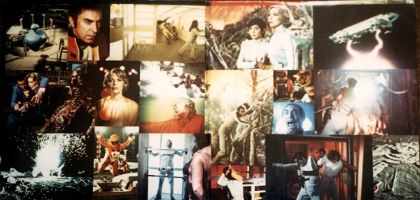
Like many young men at the time, I liked the show and bought as much tie-in material as I could find: The Charlton "Space:1999 magazine" was one (I bought a few issues, including the first), but no model kits at all. The Airfix "Eagle Transporter", for instance, never made it to my town.
One element of Space:1999 that I like, although more then than now, are the Barry Gray music scores. When RCA records released an "original television soundtrack recording" vinyl record LP of the Gray music I snapped it up... well, when I discovered it in the bin at Sam the Record Man, that is. This would have been late 1976. I remember playing it for the first time at home and being a little disappointed in the music selections. After I had grabbed the record in the store and flipped it over to the back side I scanned the track titles. These were all named after episode titles (no track called "Koenig Pops His Top, Again!" or "And Yet Another Explosion"), but after spinning the vinyl, I realized that the titles were arbitrary; there was no music from "Breakaway" on the cut called "Breakaway". And the cool 'travelling' music from "Dragon's Domain" was not on there ― I had not known that the piece was called "Adagio in G-minor" and that it had been written by a composer named Tomaso Albinoni; although that attribution is debated today. Also, I had seen the Norman Jewison picture Rollerball (1975) and remembered the tune being used there, too. To top off the Confusion in F major, there were two obvious "that's not from the show" moments.
Once I got past the little surprises including the rather brief track lengths ― there was a lot of looped "bing bong boong baa, bing bong boong baa" gobbling up valuable time between each cut ― the album was a fan's fix.
I still have the LP; it's packed away in a box somewhere (I know where). One of the very few times I have put it on the platter in the last forty years was in the summer of 1994 when friends were visiting. Somehow the subject came up: Perhaps it was my British friend Paul who mentioned "nineteen ninety-nine". Onto the Akai direct-drive turntable went the vinyl. Considering we were no longer fans of the program, some of us would have been mild ones at best when Space:1999 originally ran, we enjoyed a warm and fuzzy nostalgic time that evening.

"SPACE:1999"
- An Original Television Soundtrack Recording -
Music Composed
by
Barry Gray
RCA
1976
* * *
Space:1999/50 ― 30th Anniversary Mega Set (DVD)

Why would I want a complete series DVD set of a show I left behind in my youth, and have vague fond memories of enjoying when its parts were first broadcast? It must have been the agreeable price — the exact outlay of cash is lost to sixteen or seventeen years ago.— for all forty-eight Space:1999 episodes in one box:
"Space:1999 — 30th Anniversary Edition Mega Set"
Scanning the back of the box reminds me of the plethora of extras, special parts that may have decided there's some space on my shelf. There's a seven-minute piece of 16mm film origination from 1976 featuring special effects director Brian Johnson and his boys as they set up and shoot miniatures for Space at Bray Studios. Watching this Johnson-narrated silent footage now reminds me of the appeal to this then fourteen-year-old model maker.
Also on the set: productions stills; Year Two behind-the-scenes featurette; pre-production artwork; a BBC behind-the-scenes segment; vintage interviews with cast and crew, including the series designer, the talented Keith Wilson.
Three episodes have running commentary: producer Sylvia Anderson's bird's-eye view is very informative, and yes, Robert Culp should have been cast as "John Koenig"; writer Johnny Byrne and writer/script editor Christopher Penfold, two pleasant chaps who talk about the ins and outs of producing a series with its own identity; and Space:1999 authority Scott Michael Bosco, an error-ridden fanboy take not worth one's time, although he does settle down and offers some intelligent analysis of "Death's Other Dominion", a superior episode.
I've since replaced this DVD set with the "Complete Series" Blu-ray set.
Why would I want a complete series Blu-ray set of a show....?"
Space:1999
- 30th Anniversary Edition Mega Set -
A&E
2007

* * *
Space:1999/50 ― The Complete Series on Blu-ray

Space:1999 was re-viewed by my adult self in the mid-eighties when CKVR re-ran it on late-night television, and I saw all of its flaws, of which there are many. This designer wants to go back in time and put some Christmas tree lights into that sparsely-detailed Main Mission set: there's nothing for the actors to do, or to look at. (The actors are forever trading plastic folders with one another.) When 1999 first aired I never got the feeling that it was 24 years into the future. A smart critic at the time noted that it looked more like five years into the future ― true, as my local Radio Shack store had more advanced-looking electronics in 1975. Also, while I watched the show in colour, the monitors onscreen were all in black & white.
Technical concerns, yes.
The scripting was the real issue, as were the characterizations ― the regular cast, that is. Some of the guest casting was inspired. Billie Whitelaw, Peter Cushing, Christopher Lee, Brian Blessed, Joan Collins, and Patrick Troughton were just a few of the stellar guest-shots who gave the programme some much-needed gravitas.
The writers tried to spin profundity by having stories, too many stories, resting all too comfortably and conveniently in ambiguity ― mix it with aliens whispering from behind out-of-focus glistening Christmas tree tinsel, and the viewer can only be swept up in the magic of it all. In Year One, that is. Year Two discovered a sense of fun, and applied it when necessary. And the 'reboot' season more or less eschewed the annoying and trying metaphysical mumbo jumbo.
When the above Complete Series Blu-ray set hit store shelves in the summer of 2019, I walked down to Bay Street Video and snapped it up. Darn right I did. My boss at the time was from Quebec, and he was very much an old fan of Cosmos:1999. He too grabbed the set....
Space: 1999
- The Complete Series -
Shout! Factory
2019

* * *
Space:1999/50 ― Space:1999 Years 1 & 2 (CDs)

In late 1976 I bought the RCA LP record Space:1999. While I was a little disappointed in the incompleteness of the album, and the seemingly interminable space-outs between the cuts, it contained music from the series ― its first season, as that was "1999" at that point.
In early 2022, with a degree of nostalgia, I welcomed a splendid Silva Screen Records CD set:
"Space:1999 - Years 1 & 2"
Barry Gray wrote material, very much in the Gray style, for Year One:
Very much in the Gray style, so much so that Gray pieces from earlier Gerry & Sylvia Anderson shows could be mixed in seamlessly with new cues. Nobody would ever know that these "library" cues hadn't been written by the composer for Space. (Like John Williams and John Barry, Barry Gray had a definite "sound".) As a matter of fact, bits of Gray's music from the 1968 feature film Thunderbird 6 were seamlessly integrated into a few episodes, including "The Last Sunset", "Voyager's Return", and "Collision Course". While I've never been crazy about the show's Year 1 title theme music, with its twanging and wince-inducing guitar riff, which winced me even in 1975, I do like a few cues, especially those that made Space:1999 seem better than it was. Listen to the show from the kitchen while you're doing dishes and you might think: "What am I missing?"
The score for the opening episode "Breakaway" sets the tone for the rest of the series, which is to be expected. For the first couple of acts, the musical strains are generally, and surprisingly, low-key, but when the big blast-away happens, we get those blasts of brass. "Black Sun" tries for the epic, with composer Gray recycling a four-note theme for horn which he originally wrote a few years earlier for the Anderson-produced feature film Doppelganger (known on this side of the pond as Journey to the Far Side of the Sun). Gray sure liked his strings, which tended to make up the bulk of his orchestra on Space:1999 since he felt they gave the stories told some sweep and grandeur — certainly that's what "Black Sun" was aiming for, even if perhaps it wasn't entirely successful in doing so. "A Matter of Life and Death" features musical accompaniment — which also stars abundant strings — that ranges from grand mysteriousness to intimate loveliness.
Any problems I had with the background music for that year were not any fault of the composer. The music editor, Alan Willis, too often retracked the same dreary bits of music: pieces not dreary on their own, but through repetition they cast the series in... dreariness. As I've joked for years: "For the opening of a typical episode, or the start of a new act, we get the same dreary music backing the same dreary shot of Moonbase Alpha."
Another depressing factor would be the lack of scoring variety: Gray was asked — the scripts asked — for music of a fairly unified tone and timbre. The series producers and scripters had such a fixation on the darkness of outer space that an inflexibility too often dictated dark and brooding tonalities, episode to episode. There certainly was no equivalent to a "Jerry Fielding and 'The Trouble With Tribbles'", and that was a shame. As Year 2 incoming producer Fred Freiberger said after screening Year 1 episodes before really digging into his job as part of his mission to improve matters: "Doesn't anyone know how to smile in Space:1999."
Derek Wadsworth jazzed Year Two to great effect:
As I noted in my piece exploring Space's Year 2 opening titles, "Wadsworth grooved with the gardens of playful levity in the Grove of Psyche". While my reference is episode and scene specific in that case, specifically from the second season's opener, "The Metamorph", the idea that happy and warm music made their way onto Space:1999's variable-area optical audio tracks gave one hope that not everything in the series was dark and brooding, wallowing, and suffocating, in its own self importance. Wadsworth could also write pieces of some intensity when called for. His cues for the episode "Space Warp" did not exactly hang about, floating blissfully in pools of pleasure. After all, there was that titular space warp to deal with, and the composer did just that with staff-lines running a frenetic trombone chorus. At times it's almost out of control — as out of control as the David Prowse-manned monster from "The Beta Cloud" — and it can't be mistaken for any other Wadsworth Space score. Neither can his playful and charming music for "The Taybor". I just love those fun and oozy Alto saxophone parts. When I listen to them on this album I can't help but smile.
A standout composition, a cue written for "The Metamorph", is a pretty and enchanting piece titled "We're All Aliens", and it's a keeper. As is "Seduction" from the superior episode "One Moment of Humanity". For the dance section of the track, Wadsworth scored with a stripped-down version of Canadian jazz singer-songwriter Gino Vannelli's "Storm at Sunup". It was that song that choreographer Lionel Blair used to put actors Barbara Bain and Leigh Lawson through their paces on set during filming, so it made sense to keep the final as a close cover. In the episode it works wonderfully well. And on its own it's exhilarating stuff.
These Year 2 music tracks are eminently listenable; taken together in this particular presentation, the disc could almost act as a new-space-age album. After I finish editing and scheduling this piece, I may give 'er another spin. It has been a while since my last listen. Generally I make no bones about the fact that I think most film and television scores are best run with "picture". But some do work on their own, as music. Derek Wadsworth's own "Space:1999" theme tune is fantastic, and sets the tone for everything after.
Spotting:
Due to Space:1999's limited budget, and the terms of the then musicians' union agreement, just five episodes from each of the series' two seasons had full original music scores commissioned for them. More accurately, a total of seven shows in Year 1 had original scores: Barry Gray recorded a short percussion score at his home studio in Guernsey for the episode "The Full Circle", and a small ensemble performed pieces by Alan Willis and Vic Elms for "Ring Around the Moon".
The Off-the-Shelf Scores:
Mention should be made of Space:1999's excellent use of "library music". In Year 1, especially, this method of scoring, an initiative of limits funds, greatly enhanced what we were seeing onscreen. By way of example, Mike Hankinson's Stravinsky-like composition "The Astronauts" was tracked in part into the episode "War Games", driving and complementing the onscreen zaps and bangs, seemingly with a unseemly sardonic laugh. Beautiful. (Those Eagles sure blowed up real good... even the flat cardboard-cutout ones.)
In Year 2, few library cues were used, but a prime example of a music editor buying the right piece is exemplified in the episode "New Adam, New Eve", where Canadian composer Robert Farnon's exquisite composition "How Beautiful Is Night" accompanies a reflective campfire scene. (When I reviewed the library music cues for this article, it was obvious to me that Farnon was a favourite composer of Space's music editors, with his works being licensed a few times.)
A few library tracks are represented on this album. A sampling would include those used for the episodes: "Dragon's Domain", "Mission of the Darians", "The Infernal Machine", and "The Testament of Arkadia"... all Year 1 shows.
The Recordings:
All tracks are in stereo, with the recording quality being of an expected high standard.
In Essence:
Both series scores work in that they match, respectively, Space:1999's seasonal timbres....
Year One: winter
Year Two: summer
Space: 1999
- Years 1 & 2 -
Music
by
Barry Gray
and
Derek Wadsworth
Silva Screen Records
2021

* * *
Space:1999/50 ― Space:1999, Cancelled:1977
To be honest, I don't remember hearing that Space:1999 had been cancelled. It probably just fell by the wayside as we geeks went on to something more interesting. The second season ended and a third season never arrived. (No doubt TV Guide's end-of-book yellow 'teletype' page made note of the show's axing. In late 1975 it was that page that announced Space's renewal for another television season of twenty-four shows.)

Clipping from Starlog Magazine, number 5.
(click on picture to blow up)
Space:1999 was cancelled ― or left adrift ― in early 1977, or as some pundits have put it: Space:1999, Cancelled:1977. After two bumpy seasons of meteor storms, face-paint aliens, two-dimensional characterizations, soap bubbles, and even worse, disappointing viewer numbers, the colourful SF/horror UK-import television series finished its run of metaphysical mumbo jumbo and simple creatures not-so-great, ending up discarded mid-Atlantic. (The show never really caught on here in North America). Sir Lew Grade's, and ATV's, initiative to leave cathode ray marks through its own solar-deficient star-fields, while valiant, and not without conviction, was not to meet a successful syndication package. Forty-eight films did not provide enough linear celluloid to make for lucrative "stripping" (Monday to Friday at 5pm, kind of thing). If a commitment had been made to produce another twenty-four shows, more people reading this might have an idea as to what a "space nineteen ninety-nine" is. However, history has made its judgement, cheating me out of a potential conversation with someone, even someone my own age, about a "remember that show?" and leaving me with a dialogue-killing "I don't think I know that one".
It's possible that Space:1999 was simply ill-conceived, getting off to the worst possible start, cutting itself off at the landing pads, leaving itself with enough leverage to break the Earth's moon out of Earth orbit, and sending it straight to oblivion instead of planets of interest. Going through a black hole (or a "Black Sun", in Space's case) knocked the series even further from what the audience expected. Audience expectation should never be overrated. In fact, it's important for the bottom line; the return on investment. It's a business. Introducing the viewer to something a little off the beaten astro path is fine, but any such re-education program is doomed to fail if that new way of looking at space phenomena is too obtuse, and worse, unforgivingly boring. The remote channel-changer was becoming more commonplace in the mid-seventies. Treating its controllers to almost static forward narratives in the first few minutes of an episode will leave that "ep" prone to being abandoned for a mindless sitcom, and television station schedulers moving the series to a less prime time slot, or dropping it altogether mid-run.
Space's second season was aware of what had come before it, and it reorganized its own DNA as best it could without becoming another series all together, and entertained that built-in audience, if leaving those fans who truly believed that the first batch of twenty-four somehow constituted profundity feeling forgotten. While Year Two, on average, was more fun and presented characters at least resembling human beings, it was saddled with that cosmic albatross around its neck: a dusty moon running at indeterminable speeds uncontrollable and, too often, misguided. And stories demanding, but not delivering, enticing drama.
No, I'm not a "hater" of Space:1999, to use modern parlance. I was there, after all, to give something new and seemingly exciting, according to the prerelease publicity machine and its materials, a chance, but this then fourteen-year-old knew what constituted good drama and a solid sense of storytelling. I'll nuke a too-often repeated lie that we Trekkers were hostile to the new kid on the block. To use UK parlance: Rubbish! We were there with bells on! Many of us were kids, and dry sponges ― the fannish protective and reactive baggage was a few years away, at least. Keep in mind that two years earlier my friends and I welcomed The Starlost. If we became quickly disillusioned and disappointed by some strange new space vehicle, it may have been due to a feeling we were being sold VHS box cover "not exactly as advertised" content. (As collectors of physical media will tell you, what's on the covering artwork is often better than the movie itself; like finding one of those binned videotapes marked down: "Was $19.99, now $0.99!") Many of us may have gravitated back to our Star Trek reruns, which were in high rotation in 1975 - 1977, but if we ultimately rejected Space:1999, we did so because we felt that too much promised cosmic-level quality content had been left in the promotional artwork, and in the heavens, not through any perceived encroachment on our precious star treks.
I was there.
Yes, indeed.
And I remember the fabulous sights, sounds, and, disappointments... all leading to my look-back at a television series that could have been so much better, but is now wrapped tidily in nostalgia.


... and that concludes our 50th Anniversary 13-part retrospective of Space:1999. We now rejoin our regularly-scheduled programming....

No comments:
Post a Comment